
A Conversation with Sinclair Smith, Acting Chair, MFA Products of Design
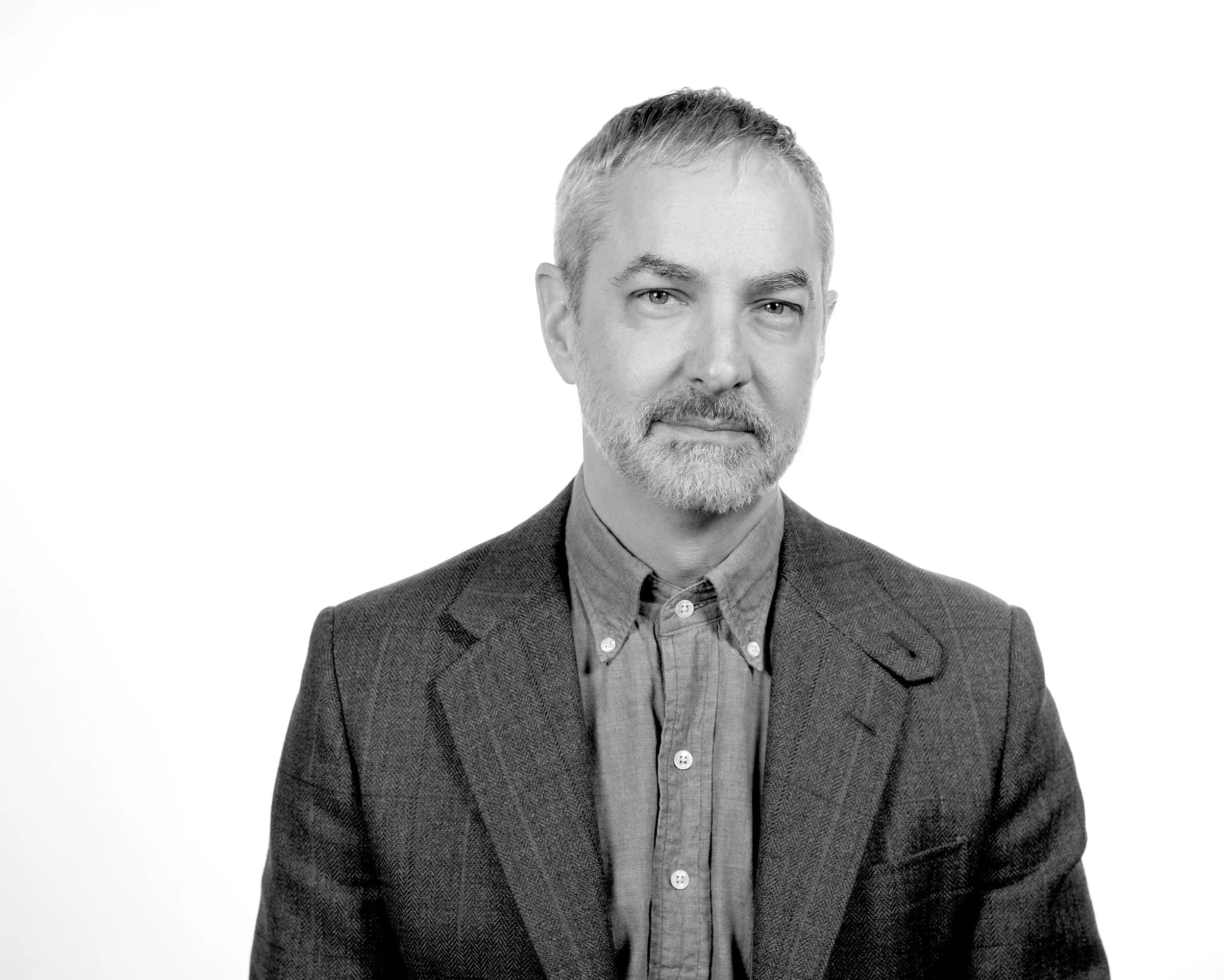
Photo by Julia Knoll
It’s Friday, April 1st, Year of the Horse. A very auspicious day. Sinclair Smith meets me in his new office–though you’d never guess by looking at the highly calibrated shelving system behind the desk, maximally loaded with design books, power tools, cards, and collected objét that give insight into an organized and creative mind. It’s as if he’s been here for ages. Sinclair sits in a black office chair with a bowl of Ricola in front of him. We like Ricola because it’s healthy sugar.
As members of the Products of Design community know, beloved founder Allan Chochinov stepped down as Chair of the Department this past December. And now, after 13 years as consigliere, Sinclair Smith, PoD cofounding faculty and Director of the Visible Futures Lab, is holding the reins.
I’m sitting down with Sinclair this evening to talk about his life, his career, and his first season as Acting Chair.
Monty: So, Sinclair, how is chair life treating you?
Sinclair: It's treating me well, Monty, thank you. Everyone has been really gracious and kind. There’s a steep learning curve, but I benefit from having been by Allan’s side while he built the department and from having worked full-time at SVA for almost ten years. Allan is surprised I don't call more often with a problem. So I suppose that’s good. I've got some nerves about all of it, but I try not to let them dominate the story.
M: So how did this happen? And what does it mean to be the Acting Chair of Products of Design?
S: Well, I think Allan came to a point where he wanted to make teaching the focus of his work again, and I was ready to step in. It was surprising but also perfect timing, I think, for both of us. And it was fast. Being chair of this department— well, acting chair… I’m not chair yet. There is typically a search to fill the position permanently. So, as they say, it’s mine to lose. But being given the opportunity to chair this department is an incredible honor and privilege, and it’s special because I’ve helped build it since we started looking at empty spaces in the buildings. I feel like it’s my baby, too. And it was nice that when we first talked about it, my proposals for evolving the curriculum and the department’s place in the landscape of design education were immediately accepted by Allan and SVA leadership.
M: It might be early to ask, but can you tell me a little bit about your approach to being chair?
S: There are two important priorities for me, maybe in life generally, which are: am I showing up for people? Are the relationships I have resounding and real? And then, is the work actually doing anything? This is a very privileged thing for me to say, and it's privileged by Allan's precedent and work, but I don’t have to worry about whether this department can succeed or not. Allan already proved it can. We did. And he sweated that. So now, what I need to focus on is whether the work continues to be there and whether we can maintain our success in today’s shifting terrains of education and employment. And are students happy and engaged and okay? Is the way that we interrogate the uncertainties and challenges of being human and then look for so-called “solution” being taught in a manner that makes a diverse student body feel seen and supported? I’m confident that I can hold our community together. I'm more concerned about the market for higher education. But I had a good first admissions season. Applicants are excited about the direction of the department, and we have acceptances that indicate a strong new cohort. So while the future feels uncertain these days, I know I thrive in ambiguity, and I think we will make it work. I've done it for clients, I've done it for myself, and the VFL is a success today. The VFL had some challenges when I came in, but I pat myself on the back for the turnaround. It was a strategic storytelling and personnel effort with a new website and a new team. Hands down, hiring Shannon Jones is one of the smartest things I've ever done in my professional life. Our demographic is young women, many of whom were raised in cultures where they were taught never to touch a tool. Shannon came in and was like, "Come on, everybody, we're gonna cross a rainbow of carpentry." Like, "F@$%, yeah, we are!" A week into her being here, I got off the elevator one morning and there was a vase of flowers in the VFL. I shed tears of joy.
“There are two priorities for me: am I showing up for people? Are the relationships I have resounding and real? And then, is the work actually doing anything?”
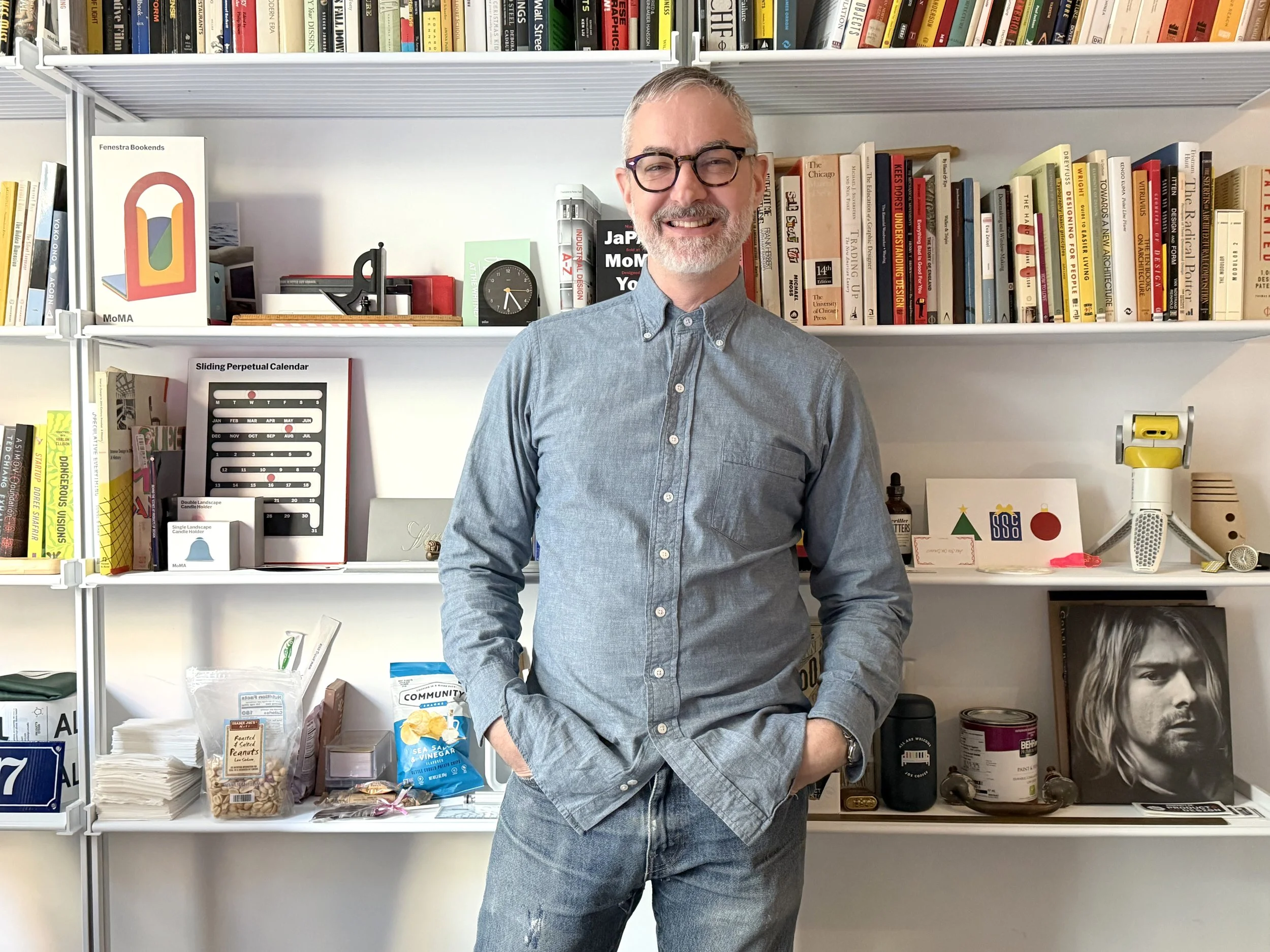
Summer reading list, coming soon!
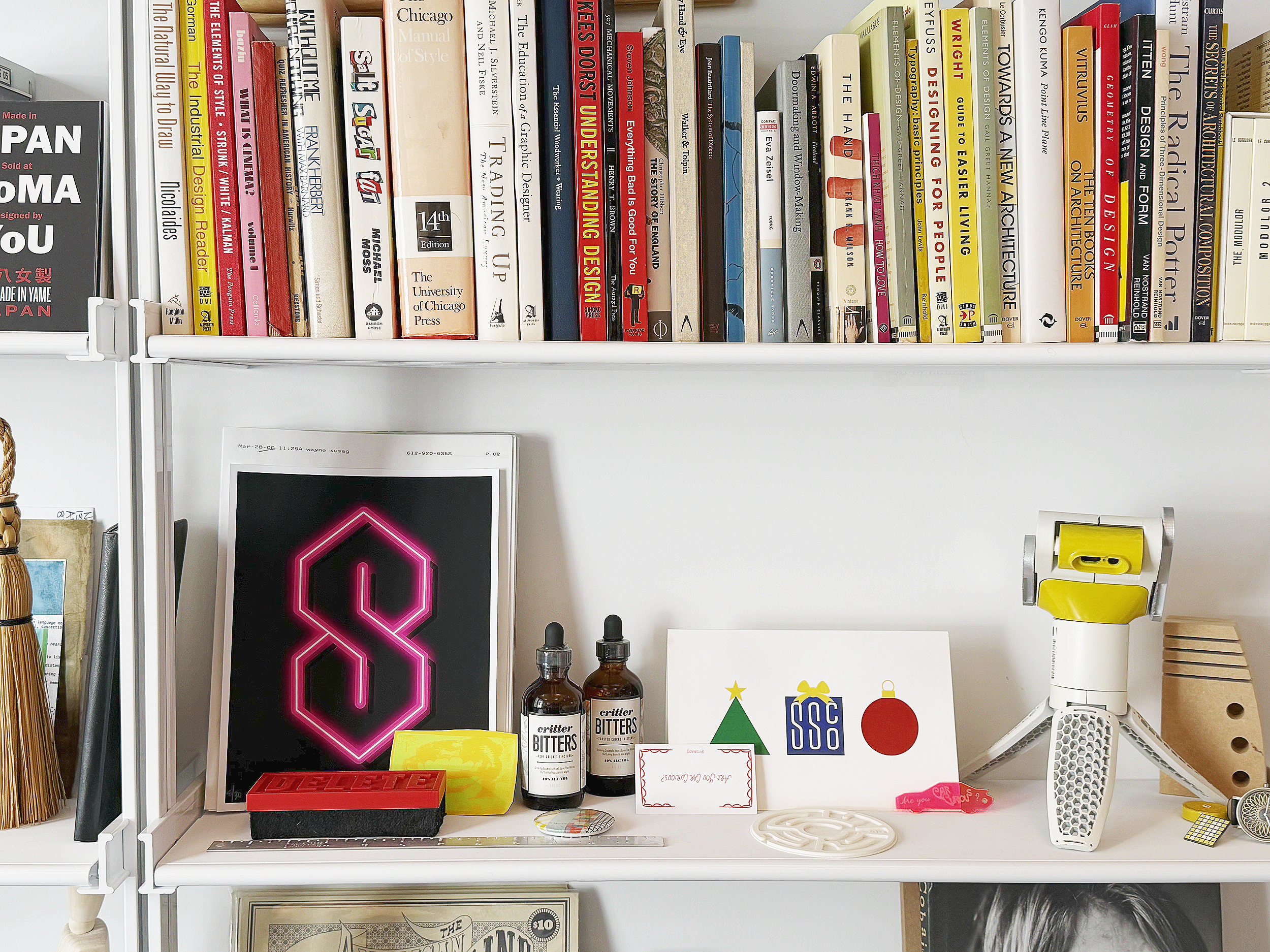
Artworks, cards and prototypes from faculty, friends and alumni.
M: Before we dig into your vision for the future, can you tell me who you are?
S: I’m Sinclair Smith [laughs]. I'm an industrial designer, and my first loves are the camera and the drum kit. I was raised in design but I always wanted to be a musician. My mother's an architect. My father was an architectural critic and historian. He trained as an actor. Very performative and insightful and culturally and aesthetically astute; he was a brilliant man. Died when I was 14. When I was looking at college, my mother—also brilliant!— knew I was an industrial designer. But I wanted to pursue music. I took a very roundabout path. I played drums semi-professionally while in film school. I worked as a cinematographer. I traveled around and taught film and shot movies and lit movies and was a fashion photo assistant and taught myself to play the guitar and played in bands, made records and wore a lot of hats and ran wild and lived a really rich young life. I did a lot of stuff. I often felt lost and, like, I didn't know where to focus. But that has paid off in experience and vulnerability that I can work with.
And then I was fortunate to be able to buy a small building in Brooklyn when I was 25 with some money from my father's death. I wanted to build a shared, creative living space for artists. I taught myself to build and became a design-build contractor and renovated apartments and stores, and did furniture and odds and ends. The contracting business wasn't my thing. But design was, and so I went back to school and got my master's in industrial design at Pratt.
That’s where I met Allan. We met in my first semester but he was not yet my instructor. I was invited to sit in on his thesis class and I gave his students a hard time. We developed a relationship and, over lunch at Mike’s, he schooled me on what was what in the new digital age of design. In my classes, my professors were teaching us essential, old-school studio chops. Allan was some new breed of multi-lateral and multi-hyphenate design thinker. He talked about design in the context of larger systems of culture and business. He helped me connect the dots between a lot of what I had buzzing in the back of my head but wasn’t yet bringing into my design practice. In my third year, I was in his thesis class for one semester. It still sort of shocks me that I spent seven semesters at Pratt, and I only spent one of them in class with him. And yet he was and has been my primary mentor since, through and through.
When I graduated, the economy was in a deep recession, but I was able to get some work and I started a studio, and it was successful. And in those years we built this department. So here I am. And that’s who I am.
M: So, where has the Products of Design program been, and where's it going?
S: Well… PoD has been at the vanguard of design education since the beginning. We got here quickly because of Allan’s brilliance and we’ve stayed here. The root of the program is Allan's early mantra that “designers are no longer in the artifacts business; they're in the consequences business”. Our move away from traditional ID pedagogy was based on the belief that all products are systems and that defaulting to the three-dimensional artifact manufactured in the thousands of units is fundamentally flawed in the age of climate change and digital scalability.
So to be ethically responsible, designers need to be multidisciplinary. They need to recognize when the job calls for a three-dimensional product, digital interaction, experience design or a simple set of instructions on how to make better use of existing resources. And they need to be sufficiently skilled to lead design teams in any of those directions. A graduate with that capability moves into design leadership quickly. So at a time when the lines between industrial design and interaction design were more blurred, the program began as a training ground for multidisciplinary product designers and thought leaders.
M: The world has changed a lot since the program launched in 2011, no?
S: It has. And the value of multidisciplinary design training is irrefutable and still central to the program’s philosophy, but we need to make some strategic changes. The first is we are going to make physical design our main focus. Whereas we have taught 3D, interaction, experience and service design equally, we will focus on three-dimensional design and teach the other disciplines in support of designing robust physical product systems.
Part of the reasoning is institutional. SVA has MFA programs in interaction, social innovation, graphic design, and branding. Given the uncertain landscape of higher education, PoD needs to better differentiate within the existing suite of SVA’s MFA programs. We can give the portfolio a more articulate and competitive advantage by focusing on physicalization.
“In order to remain smart, we need to design some friction back into the system.”
And there’s the philosophical reason. I am concerned about the health consequences of digital design excess. Screen addiction is real. So is our propensity as consumers—and designers!—to blindly pursue labor saving devices and so-called usability. The more I look at paleoanthropology and our co-evolution with our tools, the more I understand that our intelligence comes from our manual dexterity, that the two are inextricably linked. Part of what made our species so smart is the challenges we overcame in our natural environment. So as our world is increasingly shaped and controlled by industrial design, in order to remain smart, we need to design some friction back into the system.
Humans must work their hands. Children have to develop manual dexterity to stimulate imagination. They need to swing on swings to get the fluid in their ears jostling around to learn how to balance. They need to move to exercise their bodies and they also need to be bored to exercise their nervous systems and to sit with the existential shadow of being. All too much design boils down to how we are mixing neuro-chemical cocktails for restless consumers. The data is right in front of us within a generation. Digital design fosters a cognitive, ruminative experience. Being in our heads too much is bad for us. This is a wellness issue. I want design to put us back into our bodies. Through our hands. I look at the news and the world and worry we are on the edge of a global mental health crisis. If we don't remain active and productive with our hands, cultivating our roots and the individual’s value in society—especially among young men who are quite frankly the most dangerous animals in the history of the planet—then when they don't have something to do, when they cannot pick up plowshares, they will pick up guns. I do not think the news today makes this a fringe concern.
M: Some would say that per capita, the world is more peaceful, well-fed, and literate than at any time in history. How can we know what our designs today will do tomorrow?
S: Excellent question. That leads to the second area of change which is cultural fluency. More history, more studying cultural roots and identity. More taking advantage of New York. We are going to lean into PoD’s existing strengths in narratives with an emphasis on history, meaning and asking, why?
What were the customs that led to our things being developed and designed as they are? What are the components of material culture and how do they function as a language? This is what I’ve termed ethnoformology. Looking at systems of aesthetics through the lens of semiotics and linguistics, working with the elements of form and understanding that they are a malleable and evolving language to construct identity. We build culture by making meaning and value through form. By design. How? Why? I think today we're at risk of losing a collective story of who we are and how we got here. Traditional industrial design programs might give more time to hard skills like design engineering, styling and design for manufacturing. The so-called how of design. And we are going to lean harder into studio skills to be more competitive moving forward. But Products of Design has always been more concerned with the why of design, and the should. And we will continue to devote more time to history, philosophy, semiotics and behavioral psychology. Deep systems thinking. That’s where we excel.
“We’re at risk of losing a collective story of who we are and how we got here.”
M: Is studying philosophy and history going to help students get design jobs?
S: Right, well, history and philosophy will make them more strategic designers and thought leaders. That’s hirable enough. But finally, the third category is a shift toward entrepreneurship. Since the beginning, we have prioritized teaching business and leadership alongside studio craft. But our new curriculum rearranges the coursework so that students use their own thesis projects as the case studies for developing business models. As a result, they will have business proposals when they graduate. And if the world-changing design jobs they want are not out there, they will make them.
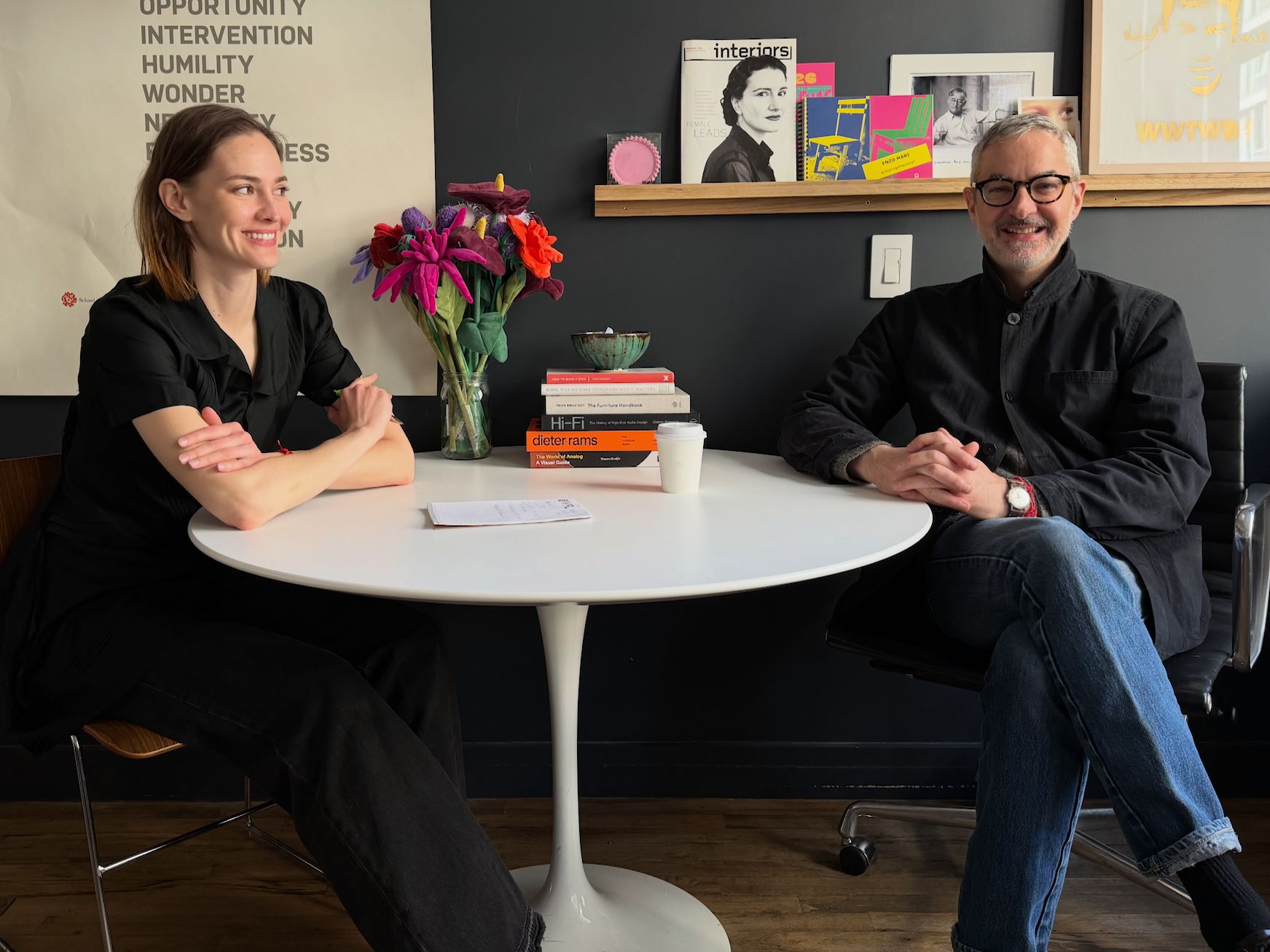
The interview, in process.
M: Who is this program for? Who will be the most successful applicants and students?
S: Makers and storytellers. A student who has some fabrication confidence so that they can be fearless with materiality and the shop. If they have some hard skills, we can focus more on sculpting their thinking and their storytelling. We like people who know how to make stuff a little bit. And then with increased entrepreneurship, it'll be a good graduate program for someone who's been, say, weaving for a long time and wants to move their textiles into a business, or wants to have a ceramics business. The other sweet spot is a storyteller, someone who really understands how to communicate and is culturally literate. They understand that product experience operates on a much higher plane of perception and valuation. Filmmakers and folks with marketing backgrounds make good PoD students because they're storytellers.
M: What's something that you believe about design that your peers might disagree with?
S: All people are designers. Design is instruction-making. And everybody makes instructions. That's fundamental human nature. Our entire communication system is built on, "You do this, and then you do this. And then you call somebody, and then you do that." Those are instructions. So everything is design. From the very beginning, the first act is just like in 2001: A Space Odyssey, you pick up the stick, and you hit it on the rock, and it breaks. And you go, "Oh, the rock is harder than the stick." And you develop causality, and then you develop sequence. And then you develop strategy. That's design. Everybody does that. The decision whether you crack an egg on the rim or crack the egg on a flat surface because in your experience, when you then insert your finger or tug your fingers or whether you've got nails or don't have nails and how it works with the friction of the surface of the egg and whether or not you wash your eggs––all of these things wind up turning into a consequence that you have to adjust for in your daily life. And that becomes a set of operating principles that are instructions that you give to yourself and that you can give to somebody else. But that's all design. Everyone's a designer.
“All people are designers. Design is instruction-making. That’s fundamental human nature.”
M: Five favorite products? They don't have to be all-time. Just in this moment. It could be five things in this office.
S: The Klein 12-in-1 screwdriver is a masterpiece of functionality and durability. I love my Dieter Rams lighter for Braun. It was my grandmother’s. I loved playing with fire. Still do. I have my father’s Loie Fuller lamp by Francois-Raoul Larche. Very special. Josh Owen’s cocktail jigger is one of the most elegant tabletop solutions going. I have a cast-iron omelet pan made by a Japanese company called Miya that is perfection. I keep my kitchen pretty clean. Not everything's hiding away or anything. I'm a maximalist. I'm an organized, cluttered person. But my cast-iron pan lives on the range. I think that’s five. My 1964 Fender Jaguar is a guitar like no other and lives beside its sister, a 1980 Gibson Hummingbird. Alessi makes or made a teaspoon I love. I don’t know the designer. I have similar spoons I nicked from British Airways and the Eurostar. This is a ridiculous list. My favorite product is the one in front of me at any moment that does its job as needed when in action and, when not in action, sings a quiet song about humanity’s miraculous co-evolution with its tools, in an endless search for order and beauty.
M: Sinclair, thank you so much for your time. We’re all incredibly grateful for your work and excited to see how the program evolves under your leadership.
S: Thank you, Monty, it’s been a pleasure, and I’m excited too.
Do you have questions for Sinclair? Reach out to us!
