
Meshes of the City: Design for Interdependence
Carmel Berg's thesis, Meshes of the City: Design for Interdependence, explores how New Yorkers relate to one another and to the systems that shape urban life. Through service design and civic data interventions, Carmel investigates how cities can move beyond models of efficiency toward systems built around care, participation, and shared responsibility. This thesis asks a fundamental question: what would civic services look like if citizens were not viewed simply as users or customers, but as active participants and co-owners of the systems they rely on?
"When something is 'efficient,' it can be hard to argue why it should change."
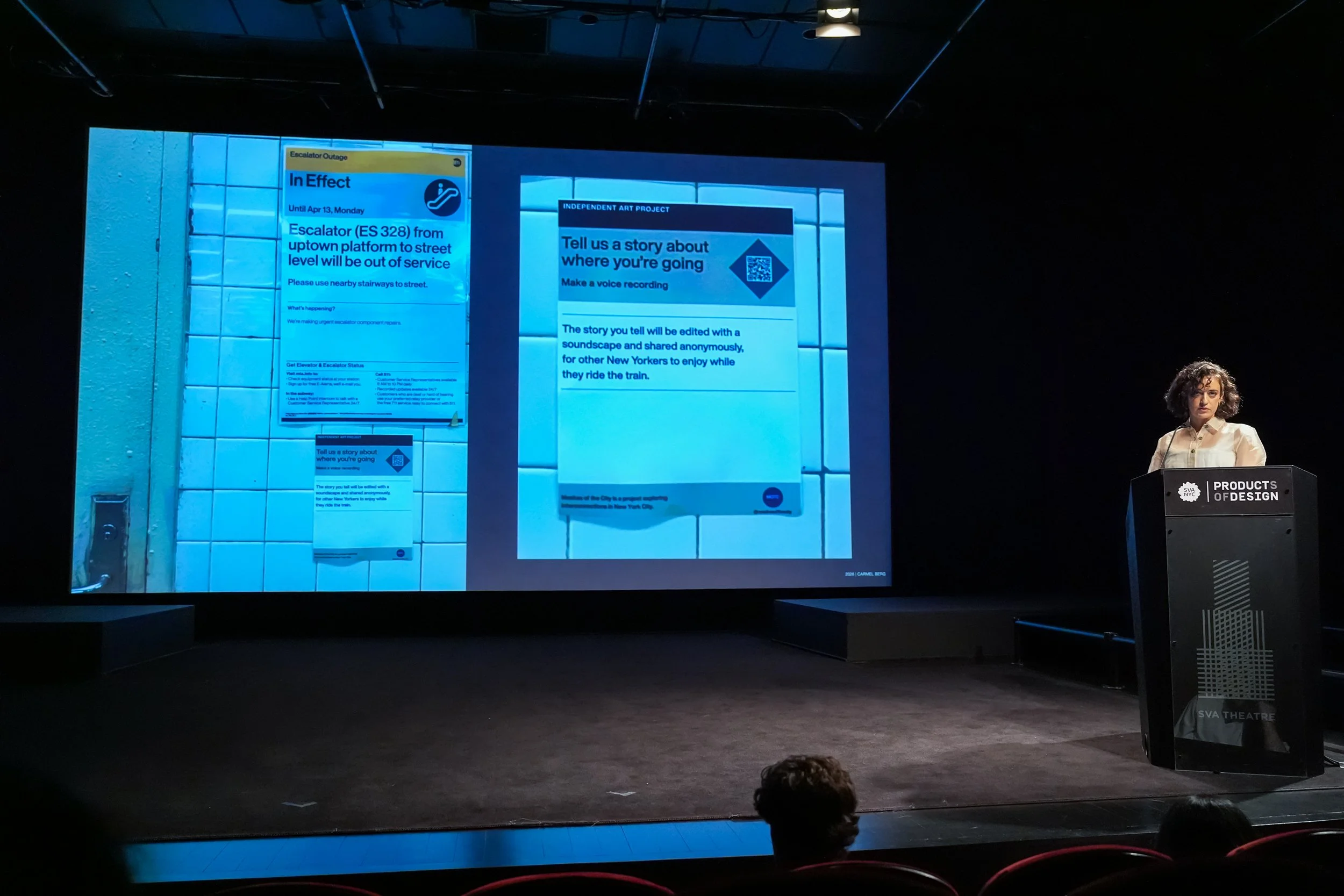





Rethinking Efficiency in Civic Services
Traditionally, efficiency has been one of the primary measures used when designing and delivering civic services. Since the Industrial Revolution, efficiency has often been associated with doing more, faster, and cheaper. However, Carmel argues that civic services are not simply products to be delivered—they are forms of care.
Within this context, a system optimized for speed and cost reduction does not always produce a better public experience. A service that is efficient from an administrative perspective may still fail to address the lived realities of the people who depend on it.
Neighborhood Maintenance Program
One way that Carmel’s thesis proposes an alternative to a purely efficiency-driven model is through the Neighborhood Maintenance Program, a service design proposal that reimagines how small-scale civic issues are addressed. The program proposes that recurring, low-level maintenance issues across different city departments could be handled by part-time workers assigned to their own neighborhoods.
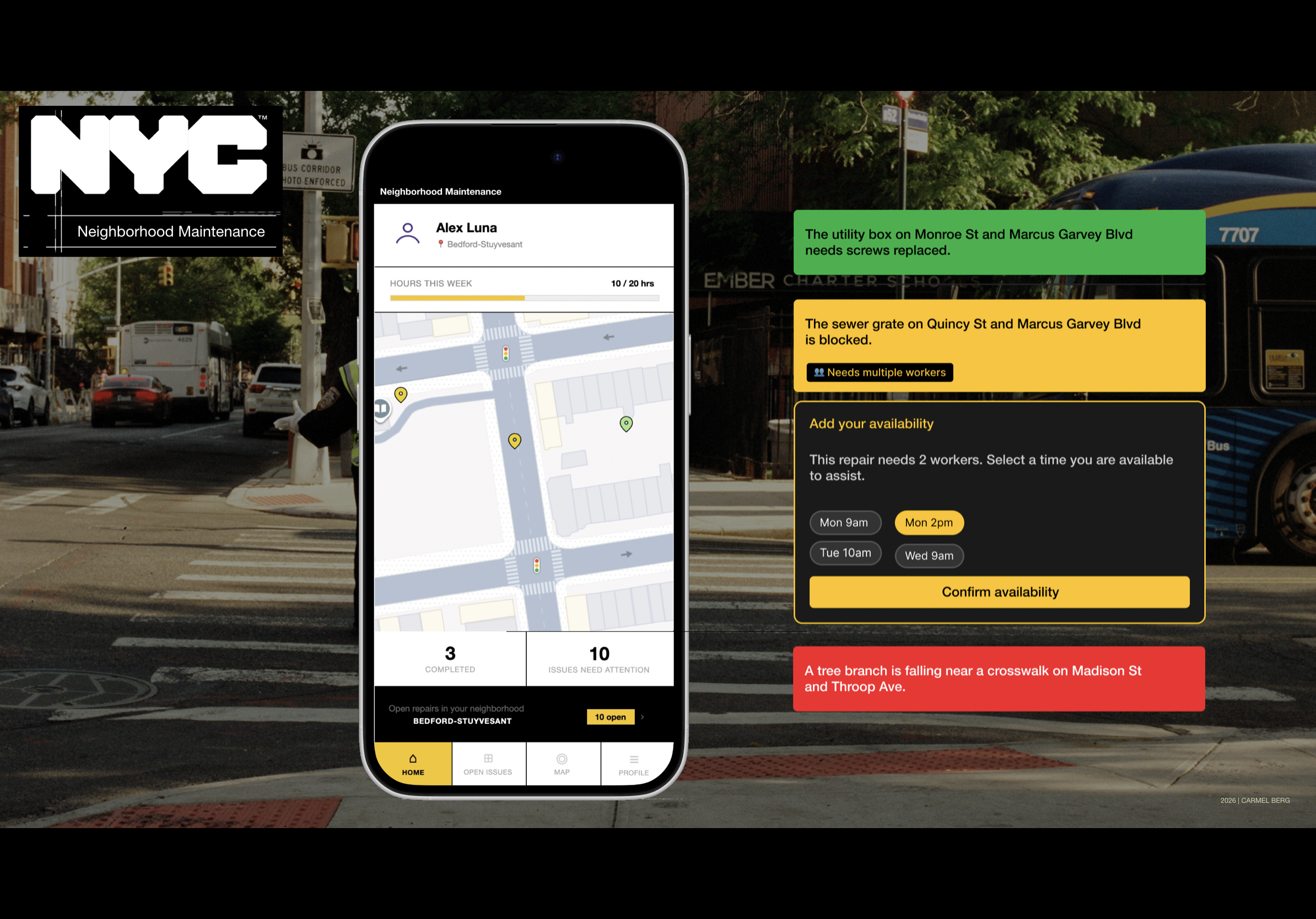
By focusing on smaller geographic areas, these workers would develop an intimate understanding of local conditions and recurring challenges. Issues that are often difficult for municipal departments to address due to backlogs or scheduling limitations could instead be resolved by people who understand their impact firsthand. Beyond improving maintenance, the Neighborhood Maintenance Program introduces a model of municipal service built around co-governance. Rather than positioning residents as passive recipients of city services, it creates opportunities for citizens to participate directly in maintaining and shaping their communities.
From Citizens as Customers to Citizens as Co-Owners
Carmel's research also examined how civic services have increasingly adopted private-sector approaches, often positioning citizens as customers. While this shift can improve certain aspects of efficiency, it also changes the relationship between residents and the city.
When citizens are treated as customers, they become end users of systems they have little role in designing. Yet civic services are not commercial products; they are shared resources that citizens should have a role in shaping.
Meshes of the City seeks to create stronger feedback loops between residents and the city, reinforcing the idea that citizens are not only service users, but co-constituents of the systems around them.
During the research phase, Carmel identified civic data as a key opportunity for creating this connection.
Rethinking Civic Data
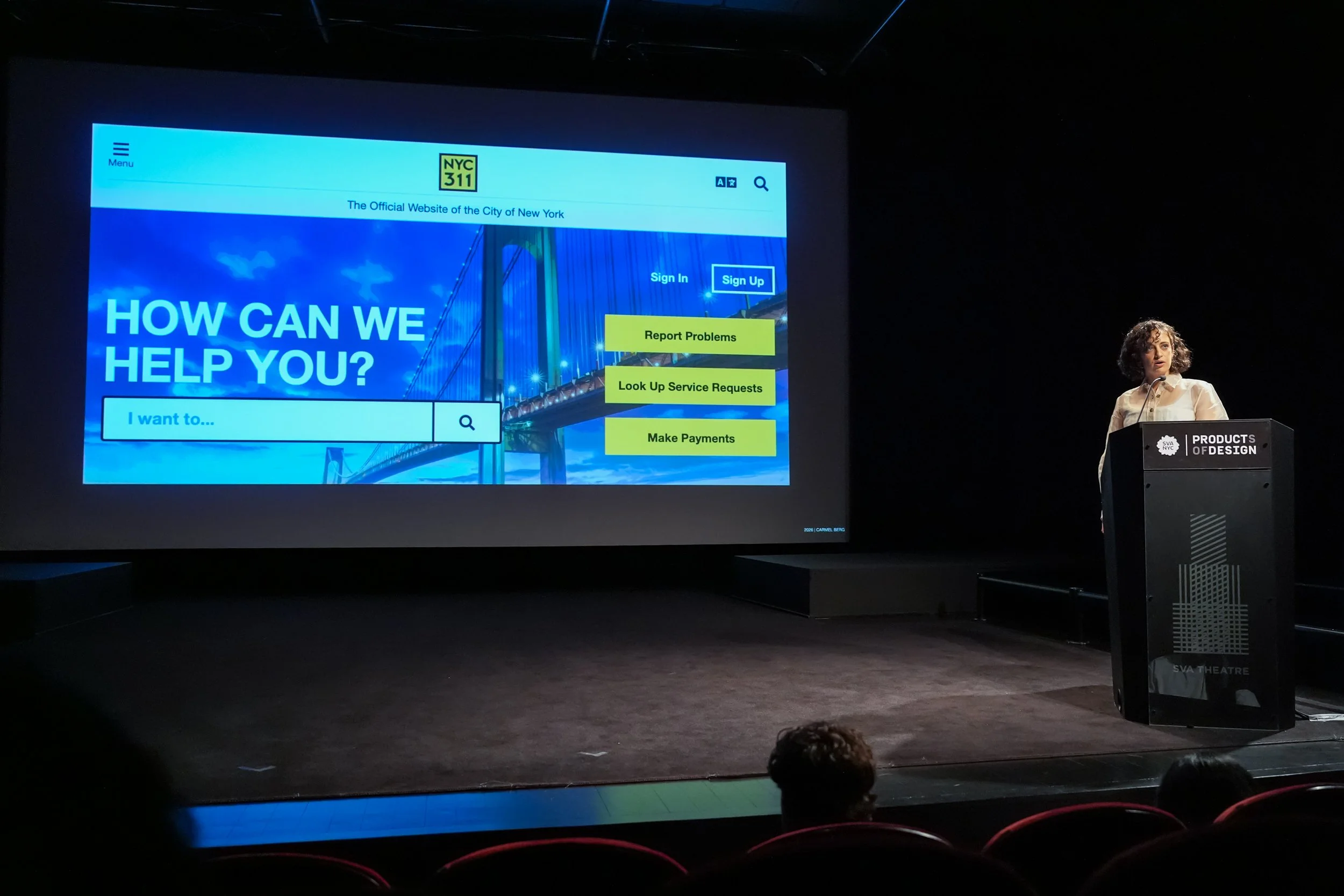
New York City's Open Data platform is a powerful example of making civic information publicly accessible. However, Carmel identified a limitation in how this information is collected and structured: because the system relies primarily on standardized data collection methods, it overwhelmingly captures quantitative information.
This data plays an important role in how city departments make decisions about services and budgets. Yet while the information is publicly available, it primarily reflects data authored by the city itself. It does not fully capture how residents describe their own experiences navigating civic systems.
"Something being visible does not mean it is legible."
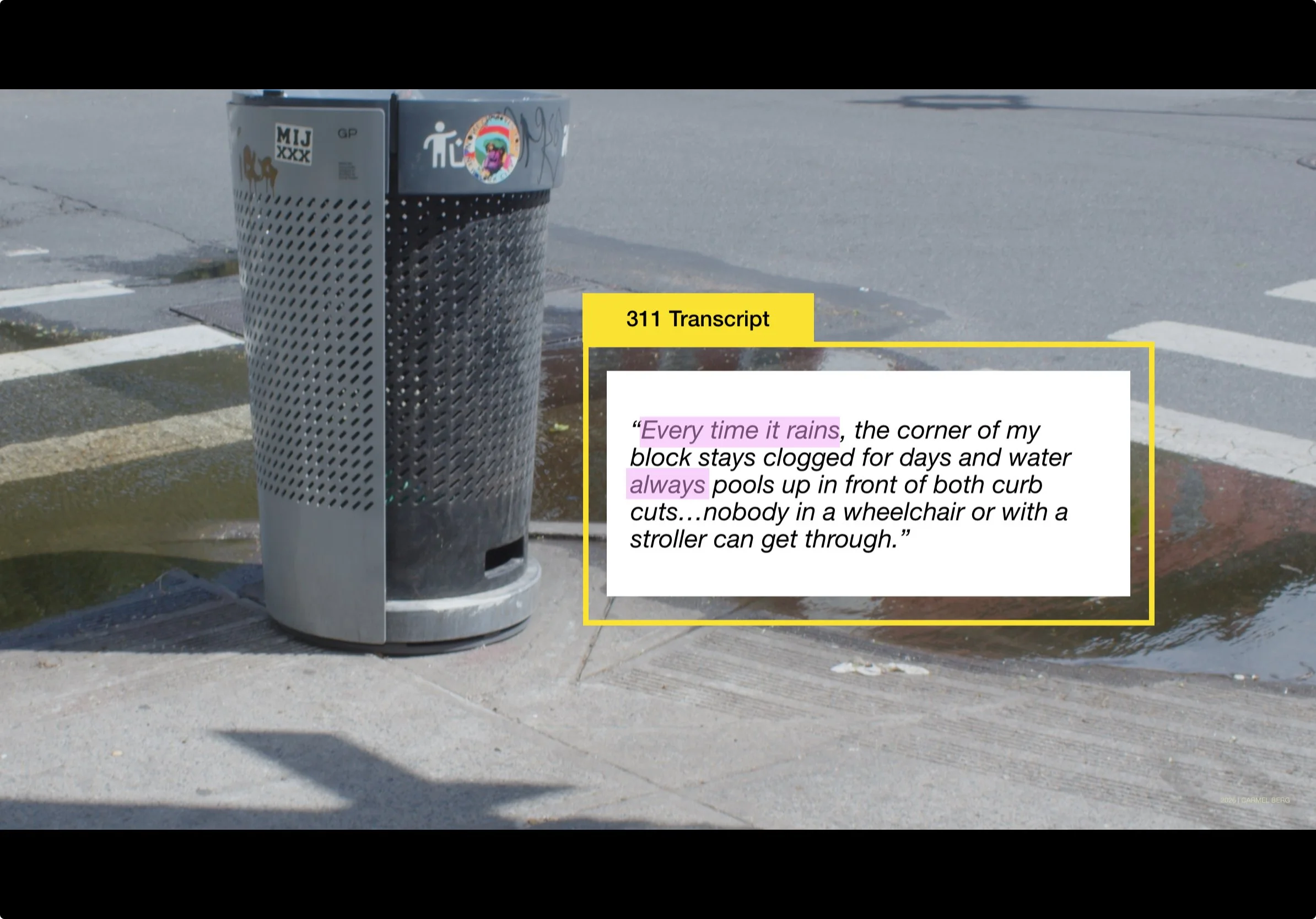
Through her research, Carmel became interested in the gap between how the city understands its services and how residents experience them. Drawing from her background in media theory, she examined questions of authorship and provenance: who creates civic knowledge, how it is recorded, and whose perspective is preserved.
Citizenset
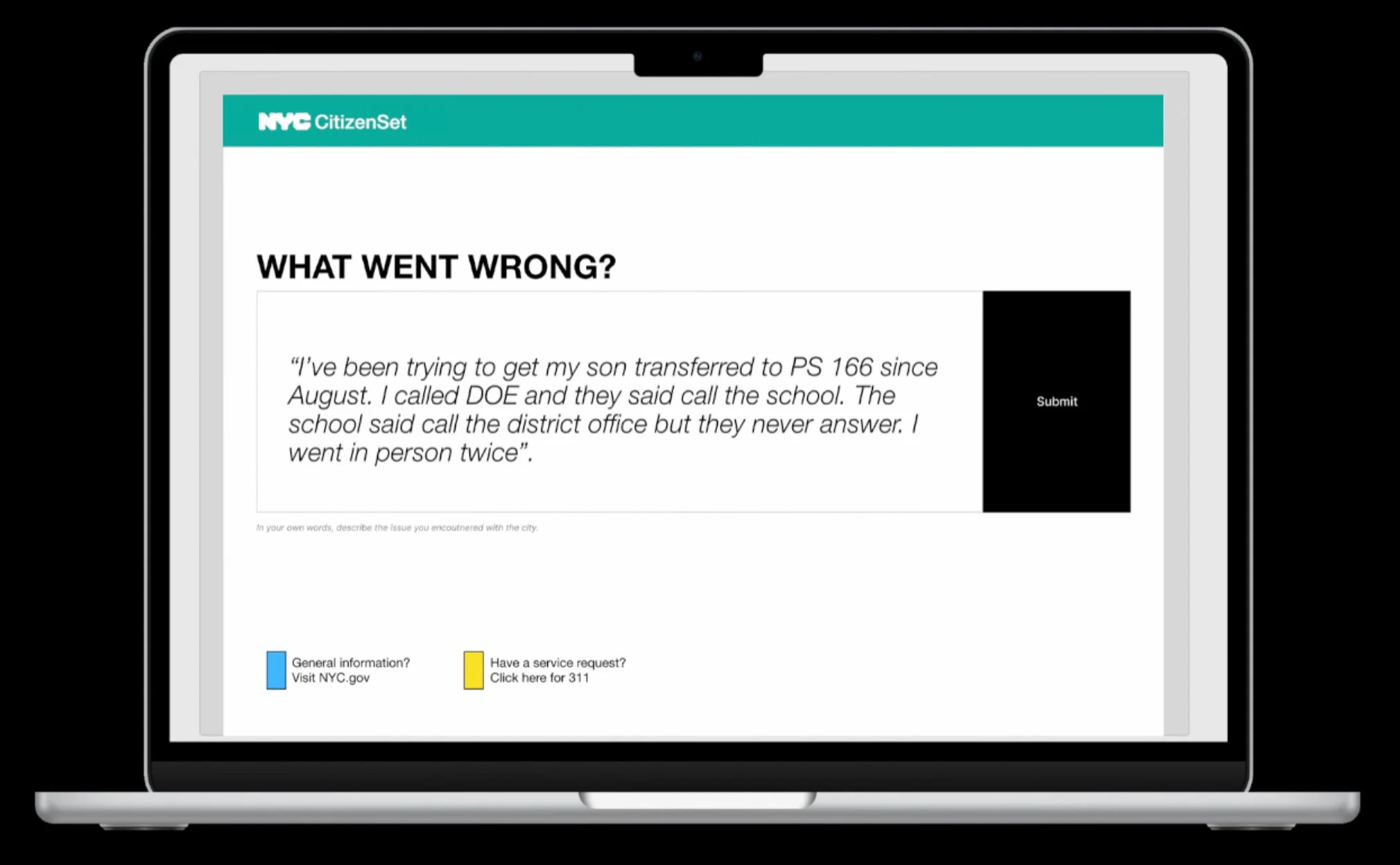
Citizenset is a companion system to 311 that allows New Yorkers to document difficulties they experience while navigating city processes. Unlike a traditional service request, Citizenset does not simply ask residents to report a problem requiring a municipal response.
Instead, it creates a way for citizens' experiences with the city to become part of the official civic record—captured in their own words.
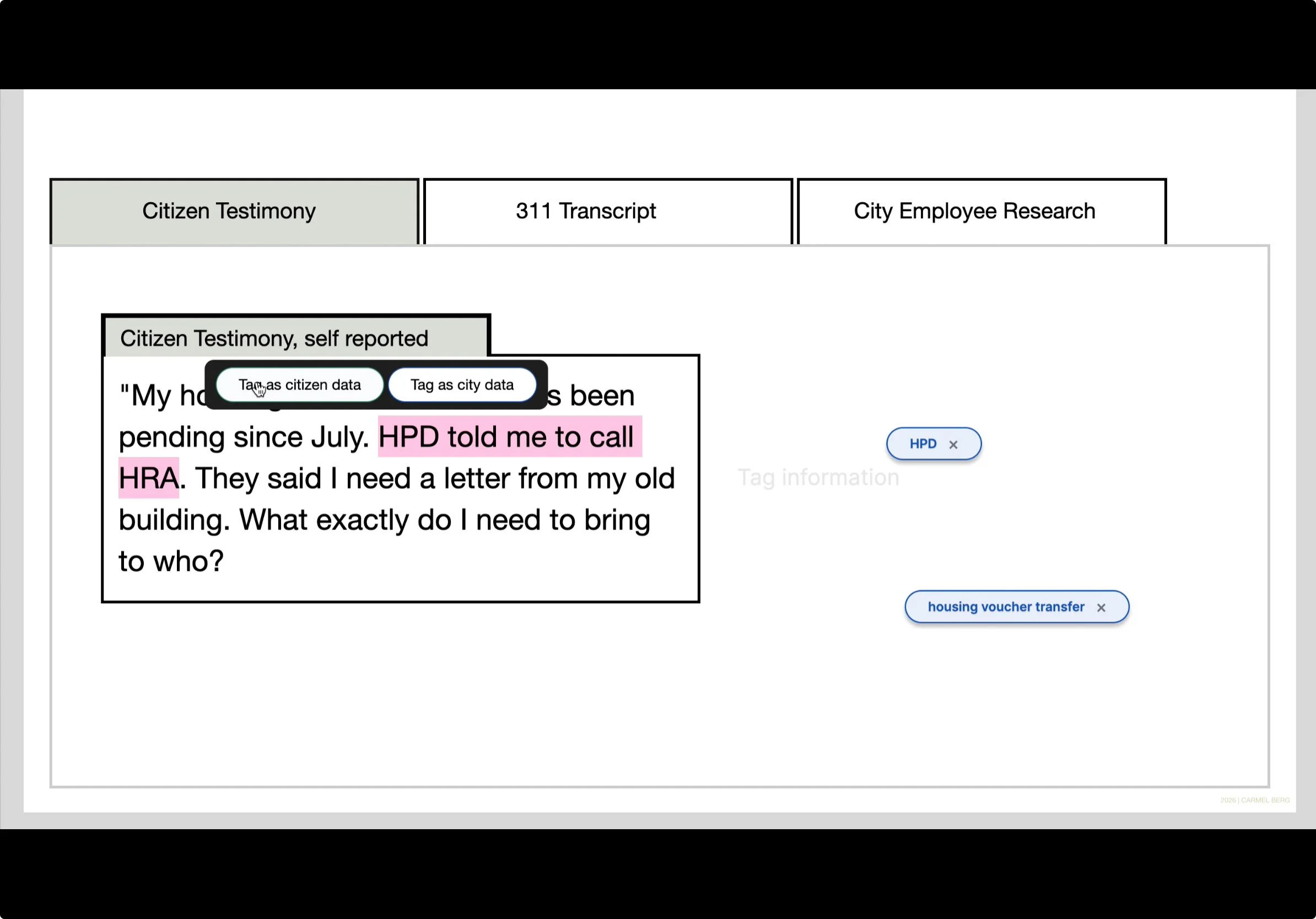
A data-tagging system allows these qualitative accounts to be organized alongside quantitative information. Rather than translating personal experiences into simplified categories, Citizenset preserves the nuance of individual stories while making them searchable and usable within civic systems. Through this approach, Carmel proposes a model where citizen-authored knowledge can exist alongside city-generated data.
NYC Dataground
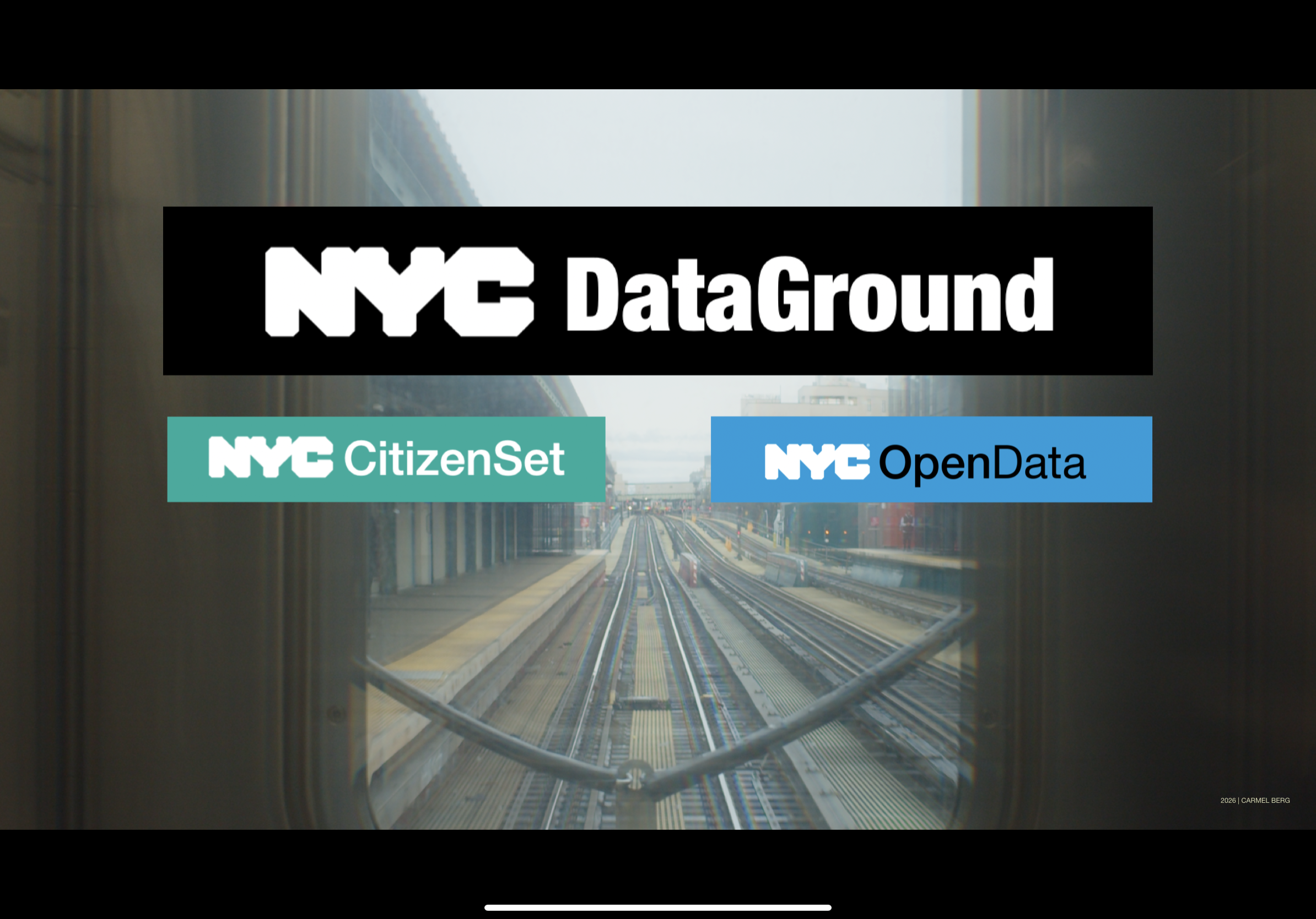
Building from Citizenset, Carmel developed the concept of NYC Dataground: a centralized informational network that combines citizen-authored qualitative data with existing municipal datasets. Rather than replacing current systems, Dataground creates a shared infrastructure through which city departments can access a broader understanding of civic needs. Department-specific tools and research systems could be built from this shared information network, allowing decisions to be informed by both statistical patterns and lived experiences.
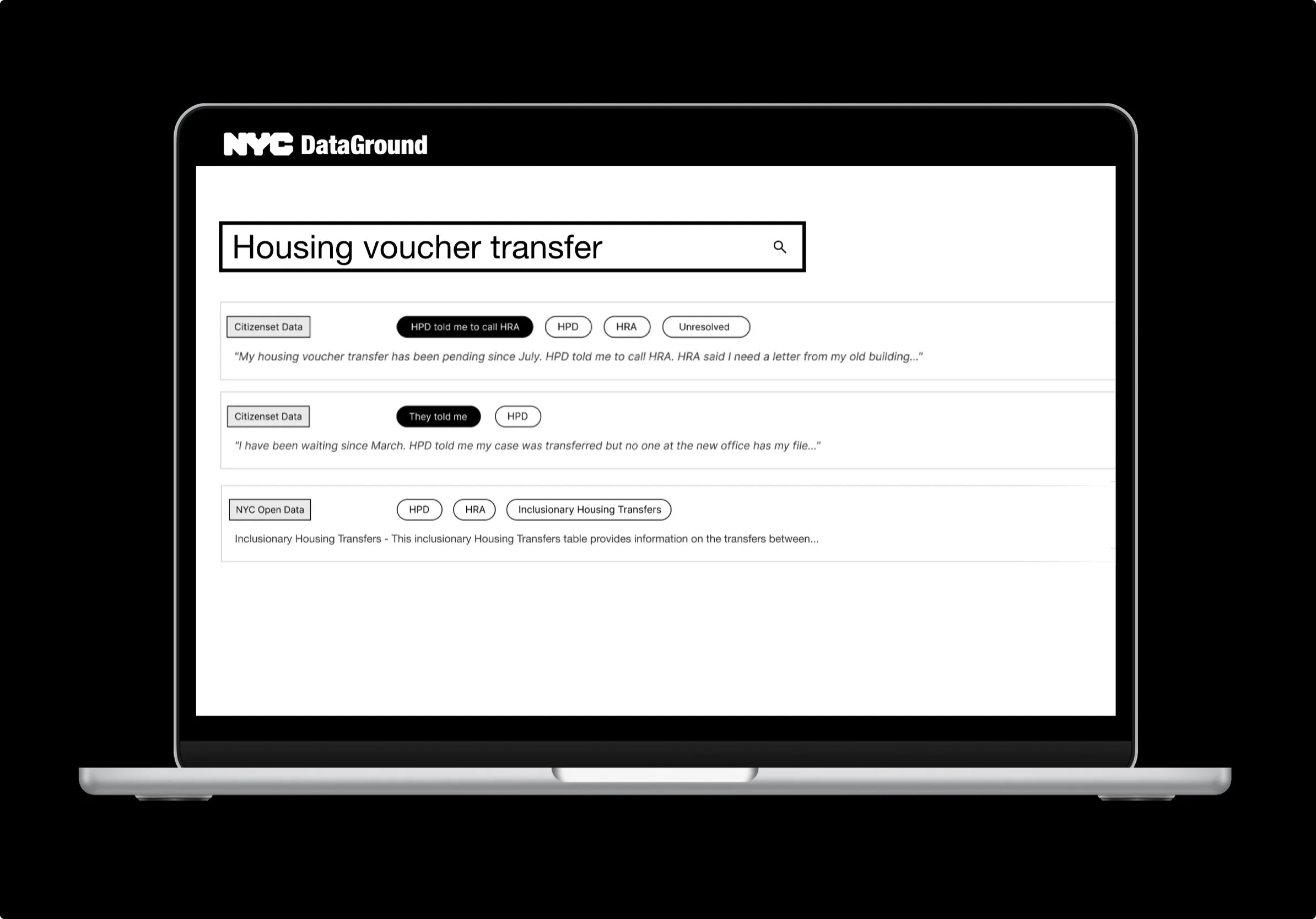
By integrating multiple forms of knowledge, Dataground proposes a more complete picture of the city — one that includes not only what happens, but how it is experienced.
The projects in Carmel’s thesis are designed to work in tandem to create better interconnection between city and citizens, as well as better interconnection between the city’s departments.
Through Meshes of the City, Carmel argues that better civic services do not come from eliminating complexity, but from designing with it. By recognizing citizens as contributors, preserving their voices within civic data, and creating stronger connections between communities and institutions, cities can move toward models of governance built on participation, care, and shared responsibility.